
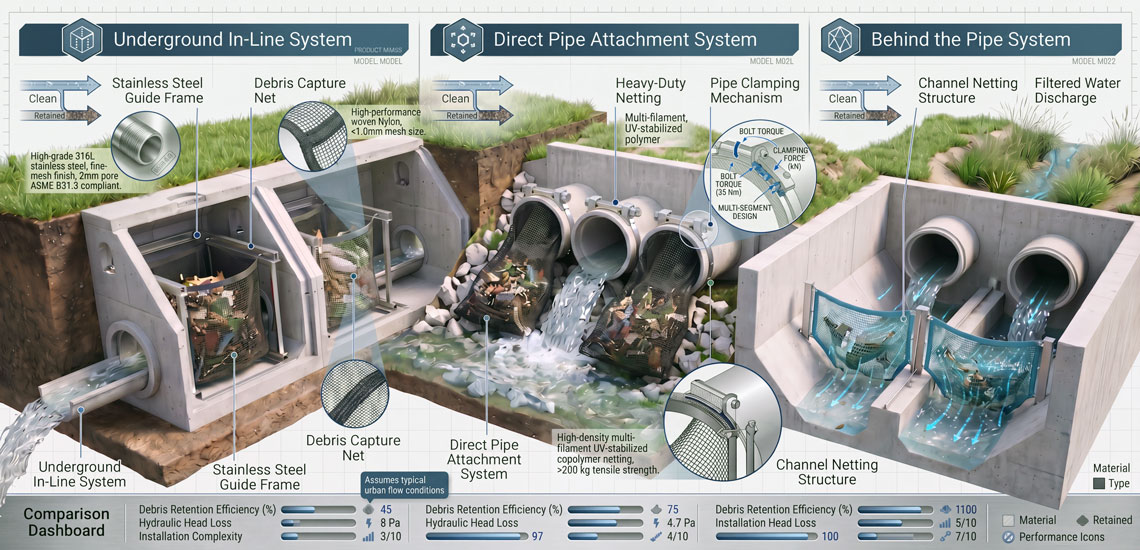
1. Underground In-line System
These systems intercept stormwater runoff before it ever reaches an open water body. They are built into the subterranean pipe network, installed beneath the surface in concrete vaults or maintenance holes. They capture trash before the water reaches the final discharge point. These require a metal guide frame and are maintained via street-level access hatches using cranes or hoist trucks.
-
Advantages: Because they are hidden underground, they preserve the natural beauty of the surrounding environment and eliminate bad odours from rotting debris. The nets are protected from UV degradation and vandalism. They also feature engineered bypasses, meaning heavy storm flows will route around a full net without causing street flooding.
-
Disadvantages: This is the most expensive system to install due to the heavy construction, excavation, and concrete required. Maintenance is also complex; clearing the nets requires lane closures, traffic management, heavy-duty cranes, and specialised crews.
2. Direct Pipe System
This is the simplest setup, where heavy-duty mesh bags are clamped or tied directly to the mouth of the discharge pipe dumping into a river, ocean, or basin and installed directly over the mouth of an outfall pipe. The water pushes the debris straight into the net. These are highly visible, easy to monitor, and typically rely on water pressure to keep the net expanded.
-
Advantages: This is the most cost-effective and easiest system to retrofit onto existing infrastructure. Visual inspections are incredibly simple—maintenance crews can see from a distance if the nets need changing.
-
Disadvantages: Their high visibility makes them prone to vandalism and theft. The netting material wears out faster due to constant exposure to direct sunlight and weather. Furthermore, if the net completely clogs with debris and mud, the restricted flow can cause water to back up into the upstream pipe network.
3. Open Channel (Behind the Pipe) System
Instead of attaching directly to the pipe mouth, these nets are anchored slightly downstream in an open concrete flood channel, often attached to a small concrete wall (weir) or metal frame and placed slightly downstream from the pipe outfall within a concrete flood channel or spillway. They are often secured to a concrete weir or metal framework spanning the channel, catching debris as water flows over or through the barrier.
-
Advantages: This system balances cost and safety. It is cheaper to install than an underground system, but safer for the pipe network than a direct-pipe attachment. If the net clogs, the water flows over the top of the net or weir and continues down the channel, virtually eliminating the risk of upstream pipe flooding.
-
Disadvantages: Installation requires an existing open concrete channel or spillway; it cannot be used where pipes discharge directly into deep or turbulent natural waters. Like direct pipe systems, they remain exposed to weather, UV damage, and potential public interference.
| Feature | Underground In-line | Direct Pipe | Behind the Pipe |
| Location | Beneath the street/ground | Tied directly to the outfall pipe | Downstream in an open channel |
| Aesthetics | Completely hidden | Highly visible | Visible |
| Installation Cost | High (excavation, concrete vaults) | Low (simple attachments) | Moderate (anchors, channel weirs) |
| Maintenance | Needs cranes and confined space gear | Manual or light machinery | Manual or light machinery |
| Vandalism Risk | Very Low | High | Moderate to High |
| Flood Risk if Clogged | Low (built-in internal bypass) | Moderate (can back up the pipe) | Low (water flows over the weir/net) |
Net Material and Reusability
The physical bags (the nets themselves) are usually designed depending on the maintenance budget and the expected debris load:
-
Disposable / Single-Use Nets: Typically made from knotted nylon or high-density polyethene (HDPE). When these nets fill with highly contaminated mud, organic sludge, and sharp trash, it is often more hygienic and cost-effective to detach the entire net, dispose of it directly in a landfill, and then replace it with a fresh one.
-
Heavy-Duty / Reusable Nets: Made from ultra-thick, UV-stabilized synthetic ropes or even wire-reinforced Mesh. These are designed to be lifted by a crane, emptied from the bottom or shaken out, and then reattached to the pipe or frame.
Mesh Size
Netting systems are customised based on the targeted pollutants, utilising different mesh hole sizes:
-
Large / Coarse Mesh (approx. 25mm to 50mm+): Designed to catch “gross pollutants” like plastic bottles, aluminium cans, takeaway containers, and large tree branches. They allow high water flow and prevent flooding.
-
Fine Mesh (approx. 5mm to 10mm): Designed to capture smaller debris, including cigarette butts, broken hard plastics, and larger organic matter (leaves). These require more frequent maintenance because they clog more quickly than coarse meshes.