
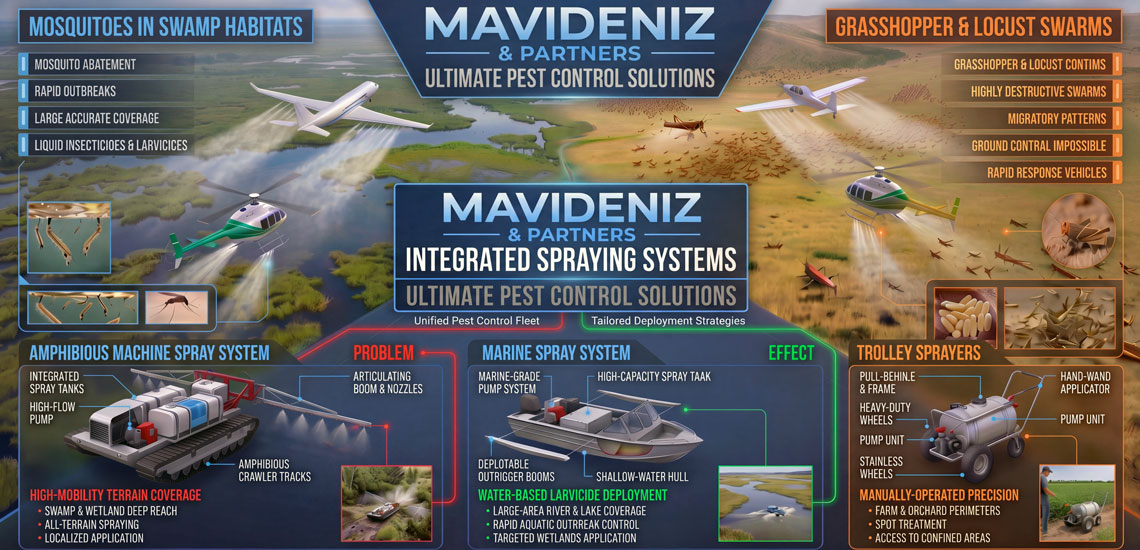
While best known for marine operations, Mavi Deniz’s Mosquito and Grasshopper Solutions focus on its heavy-duty Airborne Aircraft Spray Systems.
When dealing with rapid pest outbreaks—such as mosquito blooms in vast swamp habitats or highly destructive migratory grasshopper and locust swarms—ground control is often too slow or physically impossible. Mavi Deniz designs aerial-spraying equipment to convert standard aircraft into rapid-response pest-control vehicles.
Here is a breakdown of their solutions and equipment for mosquito and grasshopper control:
The Airborne Spray Systems
Mavi Deniz manufactures specialized spraying units that can be permanently installed or temporarily rigged onto fixed-wing planes and helicopters. These systems are used to accurately drop liquid pesticides, insecticides, and larvicides over large or inaccessible areas.
-
Helicopter Spray Systems: Designed as self-contained “underslung” bucket loads that hang from a helicopter’s cargo hook. These units contain their own tank, pump, power pack, and spraying arms, and are operated by the pilot via a remote control box in the cockpit.
-
Small Plane “POD” Systems: A highly versatile system that clamps under the fuselage of a small airplane, much like an external luggage trunk. This allows operators to quickly convert a standard passenger or cargo plane into a crop-dusting and pest-control aircraft without permanent modifications.
-
Large Transport Containerized Units: For massive, region-wide outbreaks, Mavi Deniz builds “roll-on/roll-off” modular systems. These consist of a tank, power pack, and retractable spray arms that roll into the open rear cargo hold of large military or transport planes.
Key Equipment: Mavi Spray Arial FW & Mini
Their flagship fixed-wing (FW) spray systems are customized to the scale of the outbreak and the aircraft used.
-
Tank Capacities: Range from a standard 1,000–2,000 liters to massive 18,000-liter optional tanks for heavy transport aircraft. Tanks are made of heavy-duty HDPE or aluminum.
-
Spray Booms: Available in lengths of 3, 5, 10, 15, or 20 meters to control the swamical drop.
-
F swath width low Rates: Variable flow rates controlled by a 380V 3-phase electric motor, capable of pumping between 350 andd 800 liters per minute, depending on the required density.
Strategy and Application
-
Mosquitoes: The systems are used to target standing water in vast marshlands, swamps, and lakes where mosquitoes lay eggs. The spray systems deliver targeted larvicides safely, killing the pests before they hatch without harming local food crops or drinking water.
-
Grasshoppers and Locusts: Speed is the only defense against migratory swarms. The wide-spray booms provide a rapid “knockdown” kill over agricultural belts and forests before the swarm can consume local vegetation and move on.
Because Mavi Deniz engineers these systems to have highly controlled flow rates and precise droplet sizes, the chemical application is highly targeted. This prevents dangerous over-spraying, ensuring that the local ecosystem, birds, and animals are not harmed by excessive chemical runoff.
Mavi Deniz (a prominent environmental and marine technology manufacturer) provides specialized Mosquito and Grasshopper Control Solutions, primarily centered on its multi-purpose Amphibious Vehicles and Equipment.
Because traditional vehicles cannot navigate deep water and standard boats cannot navigate thick mud or marshes, these solutions are engineered to bridge the gap in difficult terrains.
Here are the details of what Mavi Deniz’s Mosquito and Grasshopper Solutions aim to achieve and how they operate:
1. Core Objectives
Vector and Disease Control: The primary aim is to eliminate mosquito breeding grounds in swamps, marshes, stagnant waters, and shorelines to prevent the spread of diseases like malaria, West Nile virus, and dengue fever.
Agricultural and Vegetation Protection: For grasshoppers and locusts, the solution aims to suppress infestations in heavy wetlands and reed beds before they can migrate to adjacent agricultural lands and destroy crops.
Habitat Disruption: Beyond chemical application, the solution aims to physically alter the environments where these pests thrive by cutting down overgrown reeds and clearing aquatic weeds that shelter larvae and pests.
2. Key Features & How It Works
Mavi Deniz approaches pest control through highly adaptable engineering, utilizing the following mechanisms:
Amphibious Accessibility: The vehicles use ultra-low-ground-pressure tracks and pontoon hulls. This allows them to drive on land, crawl through thick mud, and float/propel themselves across water to reach isolated pest hot spots.
Targeted Spraying Systems: The machines are equipped with high-capacity spray tanks and adjustable mist/fogging nozzles. They can apply larvicides or insecticides directly to targeted areas, minimizing chemical drift and reducing the impact on non-target wildlife.
Mechanical Harvesting: By attaching T-cutters or rake tools, the vehicles clear dense aquatic vegetation. Removing this canopy exposes mosquito larvae to natural predators (such as fish) and sunlight, thereby reducing their population.
3. Environmental & Operational Benefits
High Efficiency: Covers large, otherwise inaccessible acreage in a fraction of the time it would take manual ground crews.
Eco-Friendly Precision: By allowing operators to get directly to the source of the infestation, it eliminates the need for widespread, indiscriminate aerial spraying (via planes or large drones), which can be costly and environmentally damaging.
Multi-Functional Utility: The same machine used for mosquito and grasshopper spraying can be retrofitted for oil spill cleanup, dredging, trash collection, and reed harvesting, making it a highly versatile tool for municipalities and environmental agencies.