
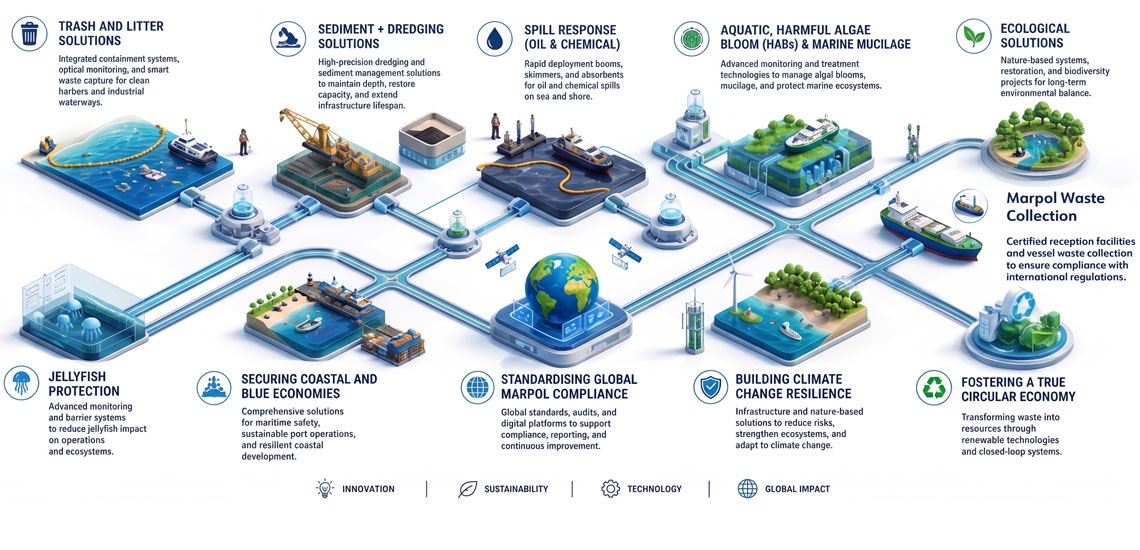
Mavi Deniz develops highly specialized, industrial-grade marine environmental machinery and services. Here is an in-depth breakdown of how they technically address each of these environmental challenges.
1. Trash and Litter Solutions
To handle floating debris, microplastics, and riverine waste before it disperses into the ocean, Mavi Deniz deploys a mix of active skimming vessels and passive recovery barriers.
-
Vessels (Sea Cat & Mini Cat): These are purpose-built Catamaran trash skimmers designed to sweep ports, marinas, and coastal waters. They feature a hydraulic front conveyor belt or basket system that skims marine litter directly from the surface and deposits it into an onboard storage hold.
-
Trash + Aquatic Barriers: Deployed at river mouths, dams, or ports inlets to form a permanent or semi-permanent fence line. They catch floating garbage carried down by rivers or tidal flows, funneling it toward a centralized extraction point.
-
Beach Cleaners: Both tractor-towed and self-propelled machines that sift through beach sand to extract cigarette butts, plastics, glass, and seaweed without stripping the shoreline of natural sand.
-
Trash Rack Cleaners: Specialized mechanical arms used at hydro-dam intakes and industrial water inlets to remove heavy debris from protective trash screens.
2. Sediment + Dredging Solutions
When lakes, ports, and riverbeds silt up or become heavily contaminated, standard excavators can cause massive environmental disturbance. Mavi Deniz counters this with highly mobile amphibious tech.
-
The Crocodile Multi-Purpose Amphibious Dredger:
Key Models: Crocodile 1000, 1400, and 1500.
These independent amphibious units feature a powerful excavator arm, hydraulic tilting stabilizers (spuds), and a propulsion system that allows them to walk off trailers straight into shallow water without the need for cranes. They can switch between a standard bucket (for rocks/heavy debris), an 800L bucket, or a clamshell bucket for delicate environmental dredging.
-
Pumping Capacity: They can mix dredged sediment with water and pump it through pipeline systems to discharge zones up to 1 km away.
-
Silt & Turbidity Curtains: To prevent sediment from choking out local marine life during construction or dredging, they manufacture heavy-duty curtains made of geotextile/PVC fabrics.
3. Spill Response (Oil & Chemical)
Mavi Deniz acts as a 24/7 Tier 1, 2, and 3 emergency contractor and equipment manufacturer for marine hydrocarbon leaks.
-
Containment Booms: They build heavy-duty inflatable booms (PVC + Polyurethane or solid Rubber) and beach-sealing booms that transition seamlessly from water to mudflats to trap oil.
-
Multi Oil Skimmers & Pumps: Using positive-displacement Archimedes screw pumps, these skimmers can recover highly viscous crude oil, fuel oil, and chemical slicks directly from the ocean.
-
Absorbents & Storage: They manufacture a wide array of specialized absorbent booms, pads, and socks, as well as portable liquid-storage pillow tanks for temporary shoreline waste collection.
4. Aquatic, Harmful Algae Bloom (HAB) & Marine Mucilage
Marine mucilage (“sea snot”) and thick algal blooms deplete dissolved oxygen, leading to catastrophic fish kills and clogged ship machinery.
-
Active Harvesting: Mavi Deniz uses its Sea Surface Cleaning Vessels (Sea Cat series) to physically filter the gelatinous, creamy mass from the water column before it can blanket the seafloor.
-
Eco-Friendly Isolation: They deploy anti-algae nets to partition off heavily affected coastal areas or beaches, allowing local authorities to clear concentrated organic matter while protecting tourism zones.
5. Ecological Solutions
These solutions blend technology with landscape restoration to mitigate human impact on rivers, dams, and ports.
-
Low-Noise Profiling: The Crocodile dredger line features a supercritical silencer system to keep noise levels exceptionally low, allowing operations to clean rivers or wetlands without disturbing nesting birds or local wildlife.
-
Vegetation Control: Using specialized cutter attachments, their amphibious machines harvest overgrowth, invasive aquatic weeds, and rooted vegetation that choke off water flow and accelerate the buildup of stagnant, rotting vegetation in reservoirs.
6. MARPOL Waste Collection
International maritime law (MARPOL 73/78) strictly regulates shipboard waste. Mavi Deniz operates licensed trucks, barges, and floating slop reception facilities (primarily in the Marmara, Aegean, and Mediterranean seas).
-
Liquid Waste (Annex I, II, IV): They offload, dewater, and treat bilge water, cargo sludge, slope, and sewage.
-
Solid Waste (Annex V – Materials Recovery Facility): Onshore, they feed shipboard garbage onto automated conveyor belts to separate paper, cardboard, plastic, glass, and metal for recycling.
-
Eco-Incineration: Non-recyclable contaminated waste is safely eliminated using EU-compliant incinerators equipped with modern scrubber towers to remove hazardous flue gases.
7. Jellyfish Protection
With jellyfish blooms increasing globally due to warming waters, Mavi Deniz built both macro-scale and micro-scale protective netting.
-
Yacht Jellyfish Protection Pools: An inflatable, non-slip PVC floating ring that drops a fine mesh net directly behind a yacht’s swim platform. The mesh allows ocean water to circulate naturally, but blocks even the tiny, venomous tentacles of jellyfish. They inflate in less than 2 minutes and offer safe swimming zones customized up to 64 m².
-
Jellyfish Barrier Nets: Heavy-duty, modular, non-permanent sea barriers up to 30 m deep designed for public beaches, resorts, and coastal power station intakes. They require no inflation on the water (preventing puncture risks) and have zero chemical footprint on the surrounding environment.
By deploying this wide-ranging ecosystem of machinery, vessels, and barriers, Mavi Deniz Marine Environmental Solutions aims to achieve a distinct set of operational, environmental, and economic outcomes.
They are effectively bridging the gap between strict international environmental regulations and real-world, high-stakes marine field operations.
Mavi Deniz’s ultimate goals can be broken down into four macro-objectives:
1. Securing Coastal and “Blue” Economies
Marine pollution isn’t just an ecological tragedy; it is an economic one. Mavi Deniz designs its solutions to protect industries that rely heavily on clean, functional waterways:
-
Tourism & Hospitality: By deploying jellyfish pools, beach cleaners, and anti-mucilage skimmers, they aim to keep public beaches pristine and safe, protecting regional tourism revenues.
-
Shipping & Port Logistics: Silted ports and litter-choked marinas halt global trade. Continuous dredging via the Crocodile and active trash skimming ensure that major shipping lanes and harbors remain navigable 24/7.
-
Energy Generation: Hydroelectric dams and coastal power plants rely on massive water intakes. Their trash rack cleaners and heavy-duty barriers prevent debris from clogging turbines, avoiding catastrophic industrial shutdowns.
2. Standardizing Global MARPOL Compliance
International maritime laws (like MARPOL 73/78) impose heavy fines on ship owners and ports that fail to manage waste. Mavi Deniz aims to provide a turnkey compliance ecosystem. By supplying both the reception vessels (slop/sludge barges) and the onshore recycling facilities, they provide international fleets with a legally compliant, seamless way to offload hazardous bilge water and solid waste, radically reducing the temptation to engage in illegal deep-sea dumping.
3. Fostering a True Circular Economy
Mavi Deniz aims to move past the traditional “collect and dump” mentality. Their objective is to turn marine waste back into a resource.
-
Hydrocarbons: Recovered oil from Tier 1–3 spills is pumped, separated, and treated for re-refining into usable industrial oils.
-
Solid Waste: Plastics and metals skimmed by the Sea Cat fleets are funneled directly into automated sorting facilities to maximize recycling rates, keeping the material out of both the ocean and the landfill.
4. Building Climate Change Resilience
As global sea temperatures rise, threats such as marine mucilage (“sea snot”), massive jellyfish blooms, and toxic algae blooms are becoming more frequent and severe. Mavi Deniz aims to provide rapid-response engineering that acts as a “buffer” for these climate-driven crises—mechanically stripping these suffocating layers from the water column before they cause localized hypoxia (mass fish die-offs) and total ecological collapse.