
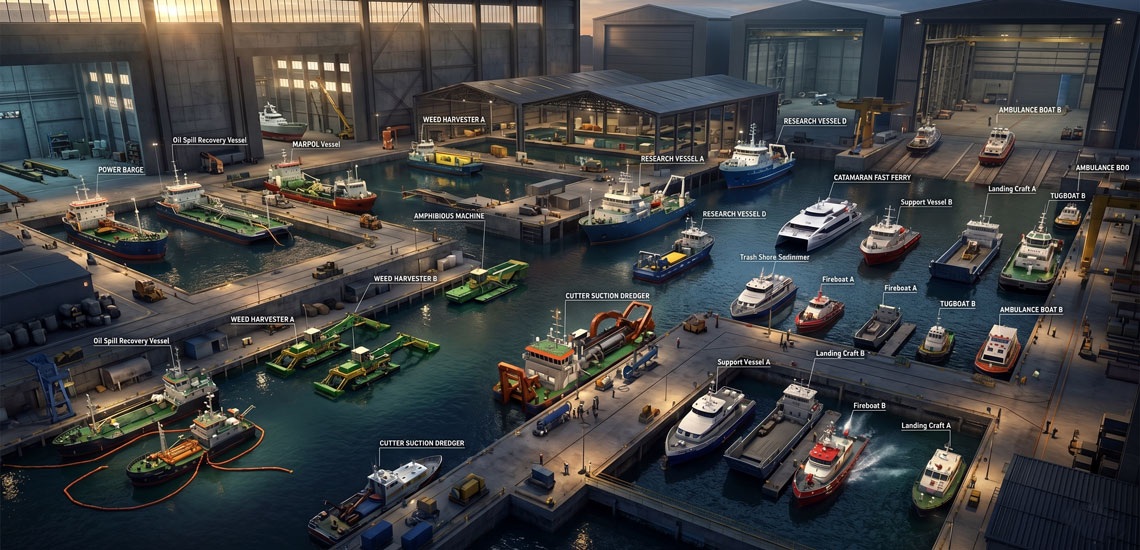
Their Newbuilding Solutions focus heavily on ecological, anti-pollution, and specialized utility vessels designed for rivers, lakes, seas, and offshore environments. Newbuilding, design, engineering, and construction of specialized, multi-purpose vessels, workboats, and marine infrastructure. Because of their background in environmental remediation, their shipyard primarily builds eco-friendly utility vessels designed for pollution control, offshore logistics, and aquatic maintenance.
Core Newbuilding Categories
Mavi Deniz constructs several classes of specialized vessels to meet international maritime and environmental standards:
-
Oil Spill Recovery Vessels (OSRV): As a world leader in anti-pollution crafts, they build dedicated oil recovery ships. These vessels are uniquely engineered with built-in skimmer systems—such as customized Catamaran Skimmer modules (brush, disc, mop, or drum)—integrated directly into the hull during construction to recover oil efficiently at sea.
-
Trash, Debris, and Weed Skimmers: They build a fleet of surface-cleaning vessels, including the Sea Cat, Mini Cat, and self-unloading skimmers. These boats are designed to navigate rivers, dams, and coastlines to harvest marine litter, sargassum, algae, and aquatic weeds.
-
Dredgers and Amphibious Machines: The shipyard manufactures cutter suction dredgers, multi-purpose dredgers, and amphibious machines used for shallow-water sediment control, mud removal, and wetland remediation.
-
Workboats and Support Crafts: For port operations and offshore support, Mavi Deniz builds High-Density Polyethylene (HDPE) Fast Crew Boats, Aluminum and GRP Patrol Boats, Boom Towing Boats, Fire and Ambulance Boats, and Catamaran Utility Vessels.
-
Barges and Waste Collection: They construct heavy-duty, non-self-propelled, and self-propelled barges. This includes Spill Response Barges, Flat Top Barges, and MARPOL Waste Collection vessels designed for lightning operations, ship waste offloading, and sludge storage.
-
Research and Passenger Vessels: Their portfolio also includes Fishery and Oceanographic Research Vessels, inshore research boats, and passenger waterbuses.
-
Passenger Vessels & Waterbuses: High-speed aluminum catamarans, crew boats (including HDPE models), and fast ferries (Fast Ferry 100/200 series) for waterborne logistics and passenger transport.
- Patrol & Inspection Boats: Aluminum and GRP (Glass Reinforced Plastic) patrol boats used for fishery inspection, harbor security, and environmental monitoring.
- Catamaran Utility Vessels: Versatile multi-hull boats used for offshore and nearshore support tasks, including boom towing and mooring.
- Marpol Waste Collection Vessels: Specially designed ice-class vessels and barges (like the Marpol Cat series) built to collect and transport ship-generated waste, oily water, and sewage.
- Emergency Vessels: Purpose-built fireboats and ambulance/medical boats for rapid emergency response at sea.
Engineering and Integration
Mavi Deniz’s newbuilding approach stands out because they manufacture both the vessel and the environmental equipment it carries. This allows them to handle everything from completely new vessel designs from the keel up to complex vessel conversions—such as retrofitting a standard workboat into a specialized recovery vessel.
Mavi Deniz manages the entire build process, often constructing in steel, aluminum, composite, and HDPE. Their shipbuilding heritage is tied to the Basaran Group, and their vessels are heavily exported for environmental remediation, port operations, and offshore logistics worldwide.
Mavi Deniz’s Newbuilding Solutions are driven by a core mission: to protect and preserve the ecosystems of the world’s oceans, rivers, lakes, and coastlines.
Rather than simply building standard commercial vessels, their shipbuilding division aims to achieve a blend of operational efficiency and environmental stewardship. Their specific goals include:
1. Active Ecosystem Protection & Remediation
The primary aim of their fleet is to provide targeted, physical solutions to environmental crises. They build vessels specifically engineered to prevent pollution at the source, rapidly respond to disasters (such as oil and chemical spills), and restore aquatic habitats by removing marine litter, sediment, and invasive vegetation.
2. Sustainable & Low-Impact Engineering
Mavi Deniz extends its environmental mission to the manufacturing process and the vessels themselves. They aim to achieve:
-
Reduced Ecological Footprints: Designing vessels that consume less fuel, operate with lower noise levels to protect marine life, and utilize highly recyclable materials.
-
Circular Economy Contribution: Implementing modern, sustainable manufacturing technologies that minimize waste and negative environmental influences, starting straight from the planning and design stages.
3. Rapid & Reliable Emergency Response
Environmental disasters require immediate action. Mavi Deniz designs its specialized utility and response boats to be:
-
Highly Reliable: Built for continuous operation under severe maritime and offshore conditions.
-
User-Friendly & Cost-Effective: Ensuring that complex pollution response systems, such as built-in skimmers and sweeping arms, are used. They are straightforward to operate, enabling crews to deploy them rapidly and efficiently during high-stress emergencies.
4. Technological Innovation (R&D)
To stay ahead of environmental challenges, Mavi Deniz aims to integrate state-of-the-art technologies into its builds continuously. This includes developing infrastructure and onboard systems that actively monitor, control, and define environmental parameters to eliminate ecological risks during operations.
5. Total Quality & HSE Compliance
They aim to strictly adhere to domestic and international maritime and environmental regulations (including MARPOL). Mavi Deniz places a strong emphasis on Health, Safety, and Environment (HSE) leadership, ensuring its vessels meet ISO 9001 (Quality) and ISO 14001 (Environmental) standards to guarantee the safety of both operators and the habitats they clean.