
Mavi Deniz Environmental Protection Services (a leading marine environmental company headquartered in Turkey that specialises in oil spill response, pollution control, and vessel manufacturing), our quality framework is closely aligned with international maritime and environmental standards.
Here is a breakdown of our quality and HSE (Health, Safety, and Environmental) policies:
1. Total Quality Philosophy
-
Core Management: Mavi Deniz bases its operations on a “Total Quality” philosophy. This means quality isn’t just about the final product; it’s integrated into our management style, teamwork, and institutional goals.
-
Continuous Optimisation: Our focus is on proactive approaches to continuously optimise our services and equipment to benefit our customers and improve overall performance.
2. Manufacturing and Operational Standards
-
Classification Societies: Because we build multi-purpose anti-pollution vessels and marine equipment, our engineering and manufacturing processes strictly comply with the standards set by major maritime Classification Societies.
-
Modern Production: We use modern logistics, manufacturing technologies, and production systems to deliver consistent, high-quality, reliable products to customers worldwide.
- Sustainability: Generate measurable social or environmental benefits alongside financial returns, creating long-term value for shareholders and society. With our entire value chain, we contribute to a circular economy. Our innovative solutions help us design and manufacture safer, more sustainable products, reduce waste, minimise environmental risks, improve health and Safety, and demonstrate traceability and sustainability across supply chains. Mavi Deniz manufactures powerful products, machines, facilities, equipment, and vessels. Using innovative logistics processes, modern manufacturing technologies, and efficient production systems, qualified employees set uniform standards for the manufacturing process, ensuring the highest quality, efficiency, and environmental sustainability.
3. HSE (Health, Safety, and Environment) Commitment
-
Generational Trust: Our quality policy explicitly states that our view of health, Safety, and the environment is an “entrustment to future generations.”
-
Sustainability: A major pillar of our quality control is environmental sustainability. Our equipment is designed specifically to mitigate the environmental footprint of industrial water usage, oil spills, and human pollution.
4. International Compliance
-
Global Leadership: Our company is recognised worldwide for the design, manufacture, and supply of pollution control systems for open sea, inland waters, and land.
-
Training Standards: Our consultancy and oil spill response training courses are designed to meet rigorous international standards, including IMO (International Maritime Organisation) Level 1, 2, and 3.
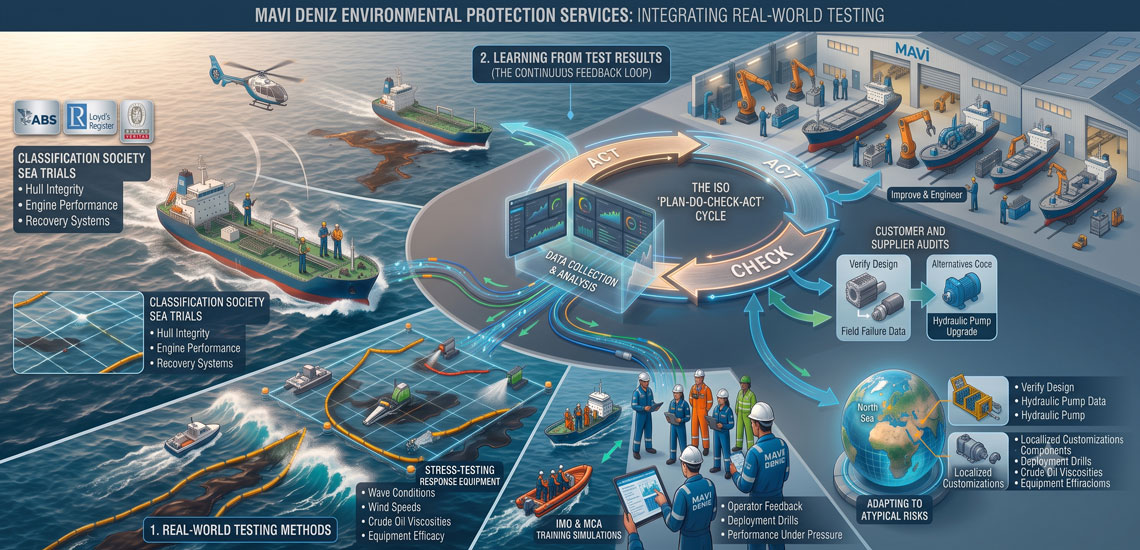
When it comes to specialised marine equipment and oil spill response, theoretical design isn’t enough; for a company like Mavi Deniz, real-world testing and learning from the results are built directly into our manufacturing and certification processes.
Because we operate under strict ISO 9001 (Quality) and ISO 14001 (Environmental) integrated management systems, our approach to testing and continuous learning works like a feedback loop.
Here is how real-world testing and data application fit into our quality framework:
1. Real-World Testing Methods
-
Classification Society Sea Trials: Mavi Deniz builds physical vessels (like oil recovery ships, dredgers, and workboats). Before any vessel is delivered, it must undergo rigorous “sea trials.” Under the supervision of major classification societies such as the American Bureau of Shipping, Lloyd’s Register, or Bureau Veritas, the vessels are tested in open water to ensure that the hull integrity, engine performance, and recovery systems function exactly as engineered.
-
Stress-Testing Response Equipment: Oil booms, skimmers, and dispersant sprayers are subjected to harsh marine environments. Our system must be tested under varying wave conditions, wind speeds, and crude oil viscosities to ensure that we won’t fail in an actual emergency.
-
IMO & MCA Training Simulations: Mavi Deniz doesn’t just sell equipment; we train people to use it. Conducting International Maritime Organization (IMO) Level 1, 2, and 3 training requires running real-world deployment drills. These live-action scenarios act as a constant testing ground for how well the equipment performs in the hands of operators under pressure.
2. Learning from Test Results (The Continuous Feedback Loop)
-
The ISO “Plan-Do-Check-Act” Cycle: our ISO 9001 certification mandates a continuous improvement loop. When a piece of equipment underperforms in a sea trial or a live spill, that failure becomes data. Mavi Deniz uses this data to redefine our”proactive approaches” and engineer out the flaws in the next iteration.
-
Customer and Supplier Audits: Mavi Deniz explicitly states that we should review our work processes, “starting with the suppliers and ending with the customers.” If field data show that a specific component (such as a hydraulic pump on a skimmer) is failing in saltwater conditions, we work backwards through our supply chain to find a higher-quality alternative.
-
Adapting to Atypical Risks: Our Health, Safety, and Environment (HSE) policy places heavy emphasis on managing “atypical risks associated with foreign operations.” An oil spill in the freezing waters of the North Sea behaves entirely differently from a spill in the humid Persian Gulf. Our analysis of performance data from these diverse geographic deployments informs equipment customisation for localised climates and specific contingency plans.
In short, for an environmental response company, a failed test or a poorly performing product in the real world can result in an ecological disaster. We rely heavily on empirical field data to evolve our engineering.