
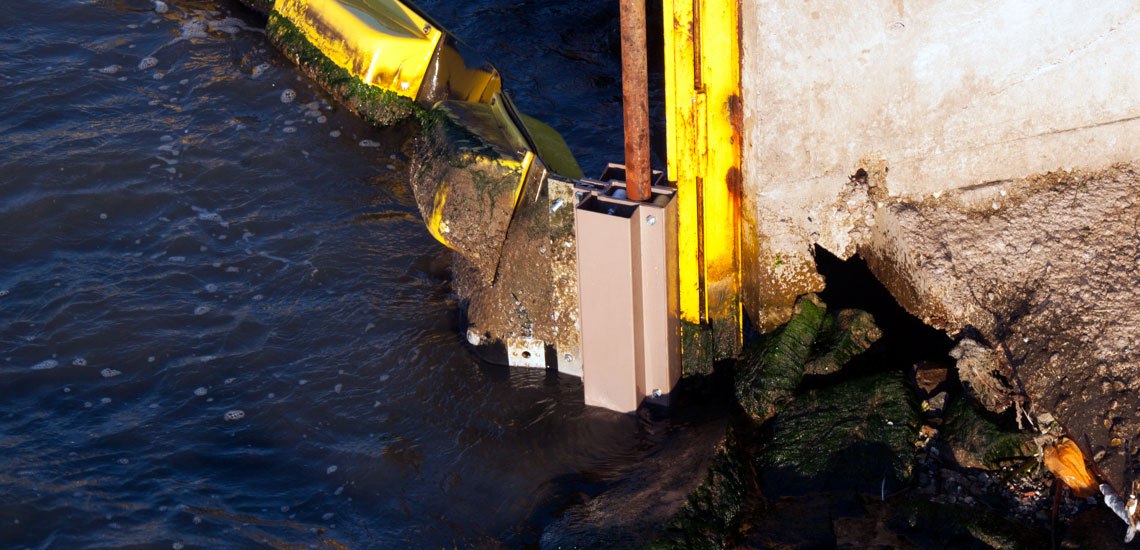
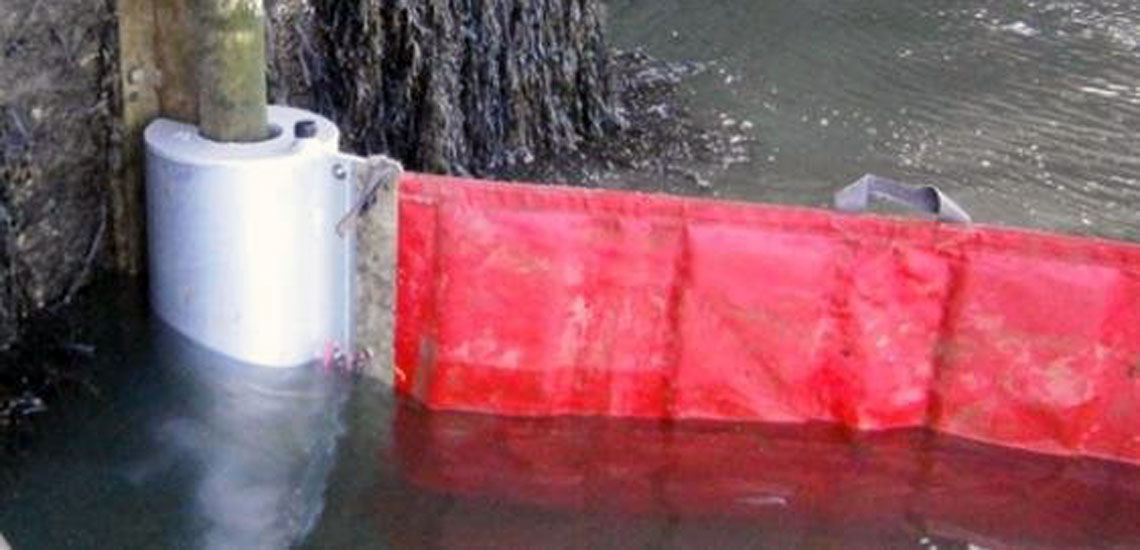
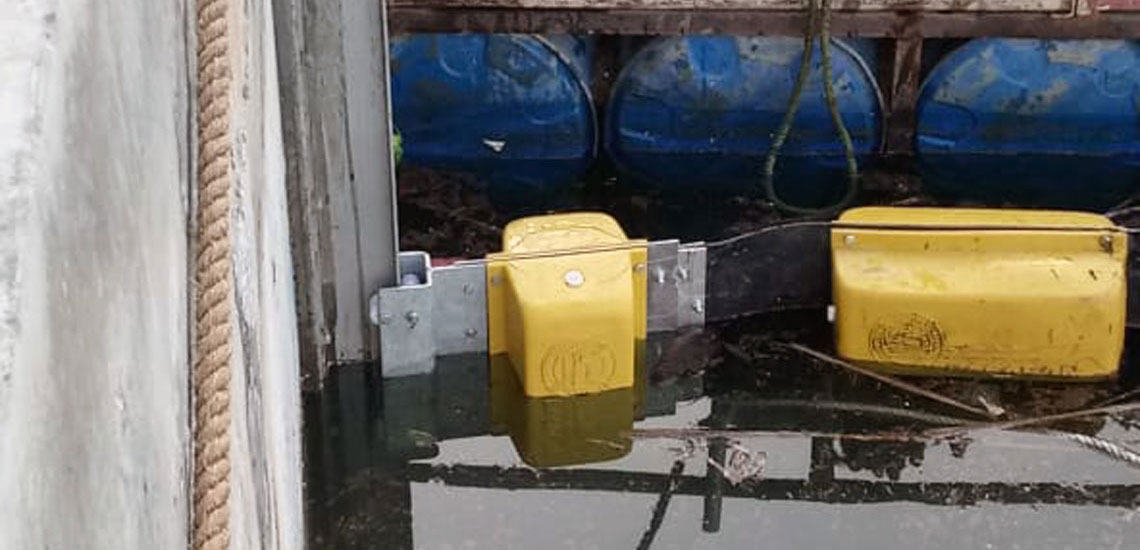
Tidal compensators are designed specifically for commercial, industrial, and environmental organizations that operate on or near tidal waters. They are heavy-duty infrastructure tools, not consumer products.
The overarching mechanical purpose of a tidal compensator is to maintain a continuous, gap-free seal between a floating barrier and a rigid structure as water levels rise and fall.
In terms of environmental and industrial applications, compensators are used to solve several specific problems:
- Oil and Chemical Spill Containment: The most critical use case. If a boom is protecting a marina from an offshore oil spill, the point where the boom meets the seawall is the weakest link. A compensator ensures the boom tracks the waterline perfectly so that surface oils cannot slip through a gap or wash over the top during high tide.
- Debris and Trash Collection: Municipalities frequently place booms at the mouths of storm drains, rivers, or canals to catch floating plastic and garbage before it reaches the open ocean. Because the boom is anchored to a wall with a compensator, the trash funnels into a neat collection area regardless of the tide.
- Sediment and Silt Control (Turbidity): During shoreline construction, dredging, or pile driving, contractors use “turbidity curtains” to keep suspended dirt and sediment from muddying the surrounding water. Compensators keep these curtains firmly anchored to the shore so muddy water doesn’t bypass the barrier at the edges.
- Aquatic Weed and Biomass Control: In areas plagued by invasive aquatic plants (like sargassum seaweed, duckweed, or water hyacinths), booms are used to block the vegetation from choking up harbours, cooling water intakes, or private docks.
- Jellyfish and Ice Protection: Coastal power plants and desalination facilities use booms to protect their massive water intake pipes from being clogged by swarms of jellyfish or floating chunks of ice.
The tidal compensator must withstand heavy marine conditions and constant motion; its installation requires securely anchoring a track system to a rigid shoreline structure.
Here is how marine contractors typically install them:
- Mount the Slide Rail: The foundation of the system is a vertical metal track—often a custom C-channel or a standard galvanized I-beam. Contractors use heavy-duty concrete anchors or marine-grade bolts to permanently affix this rail vertically against the seawall, pier, or piling. The rail must be long enough to cover both the highest expected high tide and the lowest low tide for that specific location.
- Slide on the Compensator Unit: Before the top of the rail is capped, the compensator carriage is lifted (often by a small crane or winch) and guided onto the track. The unit features heavy-duty rollers or UHMW (Ultra-High-Molecular-Weight) polyethene wear pads that slot directly over the flanges of the I-beam, allowing it to glide up and down smoothly.
- Install the Safety Stops: Once the carriage is on the track, mechanical stop blocks are bolted to the very top and very bottom of the slide rail. This is a critical fail-safe: in the event of an extreme storm surge or a completely blown-out low tide, these stops prevent the compensator unit from sliding completely off the end of the track.
- Attach the Containment Boom: With the compensator floating freely on the rail, the end of the floating boom is brought over. The compensator is equipped with an extruded aluminium connector that matches the connector on the boom (typically an ASTM universal slide connector). The boom is slid down into the compensator’s joint, and a locking pin is dropped through the top to secure it in place.
Tidal compensators are permanently installed in highly corrosive marine environments—subject to saltwater, continuous UV exposure, and the mechanical wear of tides and waves—and are constructed from highly specialized industrial materials.
Here are the primary materials used in their construction:
- Marine-Grade Aluminum (6061-T6): Often used for the slide rails, boom connector extrusion, and sometimes the compensator frame itself. Aluminium is lightweight and naturally forms a protective oxide layer when exposed to water and oxygen, preventing deep rust. It is frequently anodized for extra protection.
- Type 316 Stainless Steel: Considered the gold standard for marine hardware, 316 stainless steel is used for the heavy-duty frames, locking pins, and all fastening hardware (bolts, nuts, and washers). It contains molybdenum, which specifically prevents the chloride pitting that saltwater causes in lower-grade steels.
- UHMW-PE (Ultra-High-Molecular-Weight Polyethene): This extremely tough, self-lubricating plastic is used for the internal rollers and slide pads. It does not rust, does not absorb water, and provides near-frictionless gliding against the metal rails so the compensator never binds up.
- Hot-Dip Galvanised Steel: When building massive, heavy-duty H-beams or I-beams for the vertical slide track, solid stainless steel is often too expensive. Instead, contractors use heavy steel coated in a thick, protective layer of zinc (galvanisation) to block saltwater from reaching the raw steel beneath.
- HDPE (High-Density Polyethene) & Closed-Cell Foam: The flotation buoys that lift the compensator carriage are typically moulded from UV-stabilized HDPE plastic and filled with marine-grade closed-cell polyurethane foam. This ensures that even if a float is punctured by boat impact or debris, it will not absorb water and sink.