
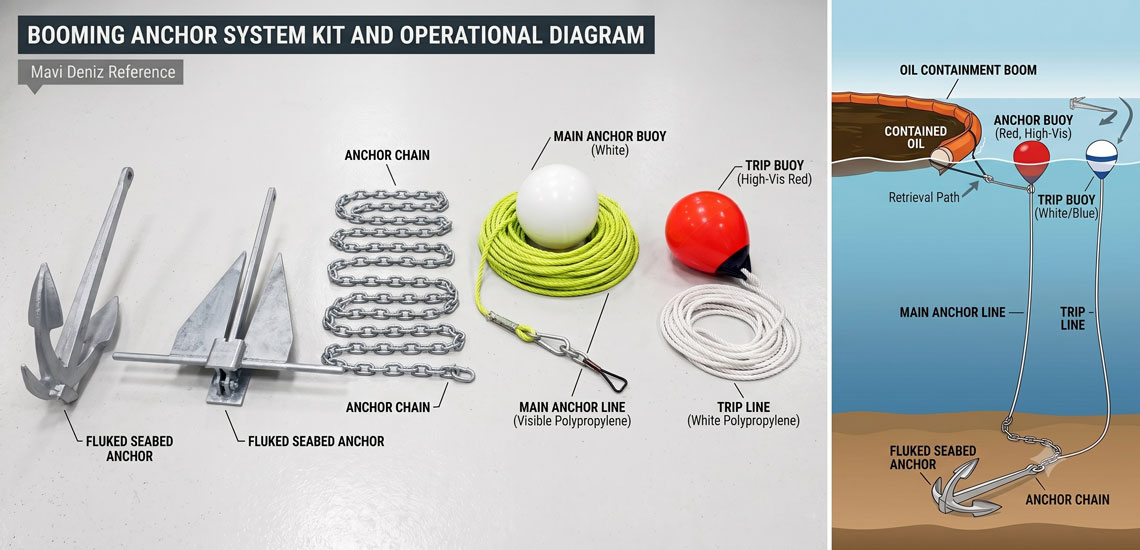
An oil boom anchoring system is the complete collection of rigging and hardware used to hold a floating containment boom in place against the massive forces of water currents, wind, and tides.
Because oil booms are highly buoyant, they are incredibly sensitive to being pulled downward. If you tie an anchor straight to an oil boom, the weight of the hardware and the drag of the current will instantly pull the boom underwater, allowing the oil to escape over the top.
To prevent this, a proper anchoring system uses a specific “floating” geometry.
The Core Components
A standard mid-water drop anchor system consists of five main parts, assembled in this exact order:
| Component | Purpose |
| 1. The Anchor | Usually a Danforth (fluke) anchor for mud/sand, designed to dig into the seabed when pulled horizontally. |
| 2. Anchor Chain | 10 to 15 feet of heavy galvanised chain attaches directly to the anchor. The weight of the chain ensures the anchor lies flat on the bottom so it can bite in, rather than being pulled upward. |
| 3. Anchor Line (Rode) | A long nylon or polypropylene rope that runs from the chain up to the surface. The length must be at least 3 to 5 times the depth of the water (up to 7 times in fast currents). |
| 4. Crown Buoy (Surface Buoy) | This is the most critical piece. The anchor line ties directly to this large floating buoy, NOT to the boom. The buoy takes all the downward force and weight of the anchor system. |
| 5. Boom Tether / Tow Bridle | A separate floating line (or the floating tow bridle we discussed earlier) runs from the crown buoy over to the oil boom. |
Environments present entirely different hydrodynamic forces and physical obstacles; responders have to change their equipment and deployment geometry for each one completely
Here is how oil booms are deployed across those four specific environments:
1. Rivers & Fast Water (> 1 knot)
In fast water, the current is the enemy. You cannot string a boom straight across, or the water will drag the anchor, snap the boom, or pull the oil underneath it (entrainment).
-
The Strategy: Deflection. The boom is used like a shield to bounce the oil toward the slower water near the shoreline.
-
The Angle: The faster the water, the tighter the angle. At 3 knots, the boom must be angled at 30 degrees to the shoreline. At 5 knots, it must be 15 degrees or less.
-
Anchoring: Mid-stream drop anchors (Danforth anchors with heavy chains and crown buoys) are used, but responders prefer shore-based anchors. They will often shoot a “high-line” rope across the river, tie it to trees on both sides, and use a pulley (trolley) system to drag the head of the boom out into the rushing water without having to drop an anchor in the middle of the river at all.
-
Cascade Booming: Instead of one long line, responders use multiple shorter, overlapping sections of boom to slowly “stair-step” the oil toward the shore.
2. Marinas (Tight Spaces & Shallow Water)
Marinas are notoriously difficult because they are crowded with expensive boats, floating docks, wooden pilings, and narrow channels.
-
The Equipment: Responders use smaller, highly flexible “fence booms” or cylindrical booms with shallow draft skirts so they don’t drag on the shallow bottom.
-
The Strategy: Protection and isolation. Responders will string boom around specific boats to quarantine a leak, or seal off the entrance to the marina entirely to keep an outside spill from entering.
-
Anchoring: Traditional heavy drop anchors are rarely used here. Instead, responders tie the boom directly to the marina’s infrastructure using existing dock cleats, pilings, and mooring rings.
3. Ports & Terminals (Vertical Walls & Tides)
Commercial ports are massive industrial environments with sheer vertical concrete walls (bulkheads), heavy ship traffic, and dramatic tidal shifts.
-
The Equipment: Massive, heavy-duty “curtain booms” with high freeboard (the part above water) to handle the wake from large cargo ships, and deep skirts to catch heavy oil.
-
The Strategy: Exclusion booming (keeping oil away from water intakes) and containment booming (surrounding a ship while it transfers fuel).
-
The Tidal Problem: If you tie a boom tightly to a port wall at high tide, when the tide goes out, the boom will be left dangling in the air. If you tie it at low tide, when the water rises, the boom will be pulled underwater.
The Solution: Tidal Compensators
To solve the tidal problem in ports, responders use Tidal Compensators (or Tide Slides).
-
How they work: A vertical steel I-beam or track is bolted directly to the concrete port wall. A specialised roller bracket (the compensator) fits onto this track. The oil boom is attached to the roller bracket.
-
The Result: As the tide rises and falls, the boom stays perfectly level on the water’s surface, rolling smoothly up and down the vertical steel track without ever binding or hanging in the air.
Magnetic Hull Attachments
When a ship is refuelling (bunkering) in port, a boom must be drawn tightly around it. Instead of trying to drop anchors on the busy port floor, responders often use heavy-duty marine magnets. They snap the magnetic anchors onto the ship’s steel hull and attach the boom, creating a tight seal against the vessel itself.