
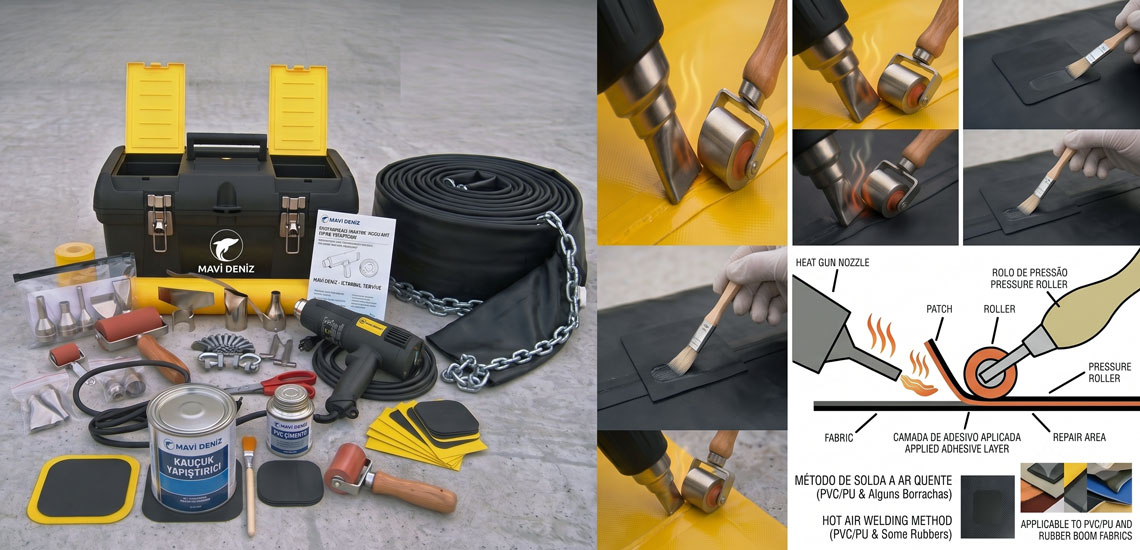
Despite the best efforts of responders, oil booms frequently suffer tears and punctures from boat propellers, submerged debris, or chafing against rocks and docks. Because even a small tear can allow gallons of oil to escape, immediate repair is critical.
Boom repair falls into two categories: temporary field patches done on the spot, and permanent factory-style welding done after the spill is over.
Here is how both are handled:
1. Temporary Field Repairs (Cold Patching)
When a boom is punctured in the middle of a deployment, responders don’t have time to send it back to a warehouse. They use specialized “cold patch” kits—heavy-duty adhesive squares that stick to wet or oily PVC and polyurethane.
Because order and preparation are critical to making the glue stick to a contaminated boom, responders follow a strict procedure:
- Clean and Degrease: Crucial for adhesion. The damaged area is hauled out of the water. Responders use heavy industrial degreasers and wire brushes to scrub the oil, salt, and marine slime off the plastic. If the surface isn’t entirely clean and dry, the adhesive will fail immediately.
- Prep the Patch: A patch of matching boom fabric is cut to size. Crucially, the corners of the patch must be cut into circles or rounded edges. If the patch has sharp, square corners, they will catch on the water current and peel the patch right off.
- Apply the Adhesive: A marine-grade contact cement or a peel-and-stick backing is applied to both the patch and the boom.
- Roll out the Bubbles: The patch is pressed over the tear. Responders use a heavy metal hand-roller to roll the patch from the centre outward aggressively. This forces out any trapped air bubbles and ensures a watertight seal before tossing the boom back into the water.
2. Permanent Repairs (Plastic Welding)
Once a spill is over and the boom has been thoroughly decontaminated and brought back to the warehouse, temporary patches are usually removed and replaced with permanent fixes.
Most modern oil booms are not stitched together with thread (which would leak). They are made by melting layers of PVC- or polyurethane-coated fabric together. To perform a permanent repair, technicians use Hot Air Welding or Radio Frequency (RF) Welding.
- How it works: The technician places a new piece of fabric over the tear. They use a specialized handheld hot-air gun (which blasts air at over 1,000°F / 500°C) and wedge it between the patch and the boom.
- The Fusion: The intense heat instantly melts the plastic coating on both pieces. The technician follows right behind the heat gun with a heavy silicone roller, mashing the melted plastics together.
- The Result: When the plastic cools a few seconds later, the two pieces have permanently fused into a single piece of plastic. The repair is just as strong as the original boom and is completely oil-tight.
Foam and Chain Replacement: If the internal foam log gets crushed or waterlogged, or the bottom galvanized chain rusts out, technicians will literally cut the boom completely open, slide in a new foam log or chain, and weld the entire seam shut again using these heating tools.
Decontaminating an oil boom is a highly regulated and labour-intensive process. You cannot simply wash a boom on a dock and let the oily water run back into the ocean—that would cause a secondary spill and result in massive environmental fines.
Before a boom can be rolled up for storage or sent in for permanent plastic welding, it must go through a strict decontamination protocol to remove oil, corrosive saltwater, and marine growth (which can rot the fabric in storage).
Here is how responders establish the “Decon Zone” and clean the equipment:
- Establish the Decon Pad: Prevents secondary spills. Before the boom ever leaves the water, crews build a decontamination pad on the shore or dock. They lay down heavy, puncture-resistant tarps and build elevated berms around the edges to create a shallow, watertight pool. All washing must happen inside this containment area so the oily runoff (effluent) can be captured and pumped into vacuum trucks for safe disposal.
- Gross Removal (Scraping): As the boom is pulled out of the water and onto the decon pad, workers in full hazmat gear (Tyvek suits, gloves, face shields) perform “gross removal.” They use rubber squeegees, soft-bristle brooms, and absorbent pads to manually scrape the thickest, heaviest layers of crude oil off the boom fabric.
- High-Pressure Washing: Hot water and eco-solvents.Once the bulk oil is scraped off, the boom is hit with industrial pressure washers. Crews use hot water (often heated to over 140°F / 60°C to melt the sticky oil) mixed with specialized, biodegradable citrus-based solvents or industrial degreasers. They must carefully wash the entire skirt, the floats, and inside the metal connectors where oil likes to hide.
- Freshwater Rinse: The boom gets a final, thorough rinse with clean, fresh water. This step is critical to remove the degreasing chemicals (which can break down the boom’s PVC coating over time) and to wash away any remaining saltwater, which would quickly rust the boom’sgalvanisedd bottom chain.
- Complete Drying: Prevents mould and rot. A wet boom cannot be rolled up and put in a warehouse, or it will grow mould and mildew that degrades the fabric. The boom is hung on racks, laid out on clean tarps in the sun, or dried using massive industrial air blowers until it is 100% dry inside and out.
Once completely clean and dry, the boom is inspected for tears. If it passes inspection, it is spooled back onto a storage reel, ready for the next emergency.
When an oil boom is shredded beyond repair, degraded by harsh chemicals, or so saturated with heavy crude that the cost of cleaning exceeds the cost of replacing it, it is officially classified as Hazardous Waste (or Special Waste, depending on local environmental regulations).
It cannot be thrown into a standard municipal dumpster or sent to a regular landfill. Doing so would allow the toxic hydrocarbons to leach into the groundwater.
Here is the strict process for disposing of a condemned oil boom:
1. Breakdown and Separation
Before disposal, responders often try to salvage any clean or highly recyclable components to reduce the sheer volume of hazardous waste.
- Chopping: The massive lengths of boom are chopped into smaller, manageable sections.
- Metal Salvage: The heavily galvanized ballast chains at the bottom of the boom and the aluminium ASTM connectors at the ends are highly valuable. If possible, crews will slice the boom open, extract the metal, send it through a rigorous hot-water decontamination wash, and recycle it.
- The Remainder: What is left is a highly toxic, oil-soaked pile of PVC, polyurethane fabric, and internal foam.
2. Primary Disposal: Incineration (Waste-to-Energy)
This is the most common and preferred method for disposing of oiled plastics.
Because crude oil is essentially raw fuel, and the boom itself is made of petroleum-based plastics, a condemned boom burns exceptionally well. The shredded, oiled boom is loaded into specialized roll-off dumpsters and trucked to commercial hazardous waste incinerators.
- How it works: These incinerators burn the waste at incredibly high temperatures (often over 2,000°F / 1,093°C).
- The Benefit: The extreme heat destroys the toxic chemical compounds in the oil and plastic. Furthermore, many of these facilities are “Waste-to-Energy” plants, meaning the massive heat generated by burning the oiled boom is used to boil water, create steam, and spin turbines to generate electricity.
3. Secondary Disposal: Hazardous Waste Landfills
If commercial incineration is not available, or if the boom was contaminated with heavy metals or chemicals that cannot be safely burned without releasing toxic air pollution, the boom must be buried.
- Solidification: Before burial, the oiled boom pieces are often mixed with binding agents (like fly ash, kiln dust, or specialized polymers). This “solidification” process traps the wet oil inside a solid matrix so it cannot drip or leach out.
- Subtitle C Landfills: The waste is then transported to a highly regulated hazardous waste landfill (known in the US as a Subtitle C landfill). Unlike normal landfills, these facilities have multiple layers of impermeable synthetic liners, thick clay barriers, and active liquid-collection systems designed specifically to ensure that zero toxic runoff ever reaches the soil or groundwater below.
Here is the straightforward breakdown of how they differ and why it matters:
1. PVC (Polyvinyl Chloride) / Polyurethane
Think of PVC as the lightweight workhorse. It is the most common material used for standard oil booms today.
The Pros: It is relatively lightweight, much cheaper to manufacture, and highly flexible. Because it is lighter, it is much easier and faster for crews to deploy by hand or from a reel.
The Cons: It degrades faster under intense UV sunlight, gets stiff and brittle in freezing temperatures, and has a shorter overall lifespan than rubber.
How it repairs: PVC is a thermoplastic. This means if you heat it with a hot-air gun, it melts. When it cools, it turns back into solid plastic. You fix PVC by literally melting two pieces together (plastic welding).
2. Rubber (Neoprene / Nitrile / Hypalon)
Think of rubber as the heavy-duty tank. It is used in massive offshore booms, permanent port installations, or environments with brutal conditions.
The Pros: It is incredibly tough. It resists punctures from debris, handles extreme freezing temperatures without cracking, ignores UV rays, and can last for decades in the water.
The Cons: It is very expensive and extremely heavy. Deploying a rubber boom almost always requires cranes, hydraulic reels, or large boats.
How it repairs: Rubber is a thermoset elastomer. Once rubber is created and cured in a factory, it cannot be melted again. If you put a heat gun to rubber, it doesn’t melt; it just scorches and burns.
Why the Repair Kit Has Both Heat and Glue
This fundamental chemical difference is exactly why I added glue (contact cement) to the repair kit image in the previous step!
If you are a responder in the field and you get a tear in your boom:
- If it is a PVC boom: You grab the heat gun and the roller. You melt a PVC patch directly onto the boom. No glue is needed.
- If it is a Rubber boom: The heat gun is useless. You must rough up the surface with sandpaper, apply a highly specialised industrial contact cement (glue) to both the boom and a rubber patch, wait for it to get tacky, and press them together with the roller.