
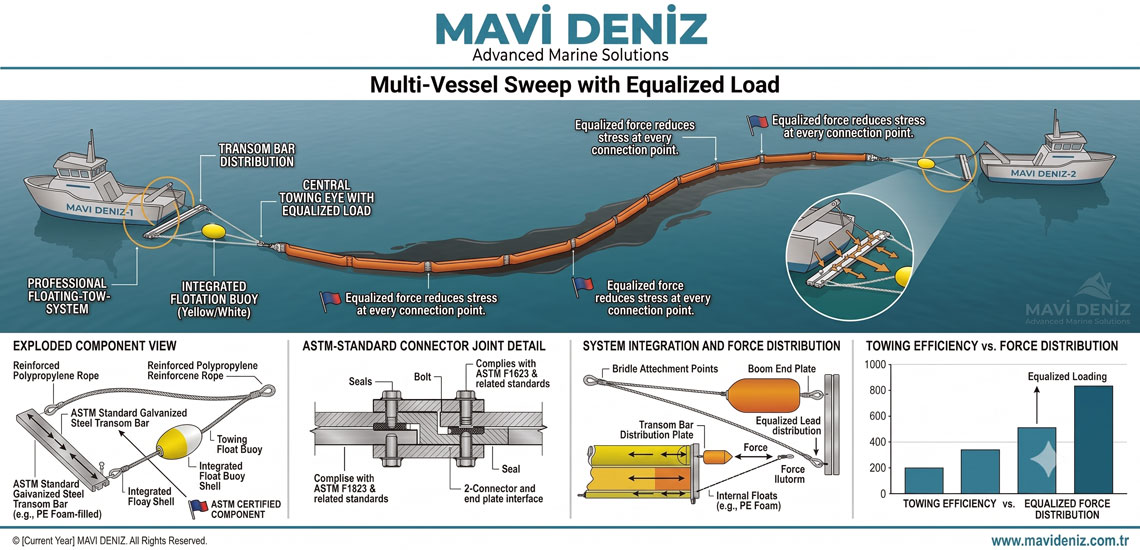

Both of these components are critical pieces of hardware used to manage the intense physical forces placed on an oil boom when it is deployed, towed, or anchored in the water.
Here is how they work together:
Floating Tow Bridles
A tow bridle is an adapter harness that connects the end of an oil boom to the tow line of a boat (or an anchor line).
When a boat pulls an oil boom through the water, the water resistance creates a massive amount of drag. If you were to tie a rope directly to the top or bottom of the boom, the fabric would twist, fold over, or rip entirely.
- How it works: The bridle consists of a rigid vertical bar that matches the height of the boom. Cables attach to the top and bottom of this bar and meet at a single point (forming a triangle) where the tow boat’s rope connects.
- Why it “floats”: Heavy steel cables and hardware will naturally sink. If the bridle sinks, it pulls the end of the boom underwater, allowing oil to escape over the top. To prevent this, foam buoys are threaded onto the upper cables of the bridle to keep the entire assembly on the water’s surface.
Boom Connectors
Oil booms are usually manufactured in sections ranging from 50 to 100 feet long. To create a continuous barrier that might span miles, these sections must be securely linked together. Boom connectors are the heavy-duty joints at the end of every boom section.
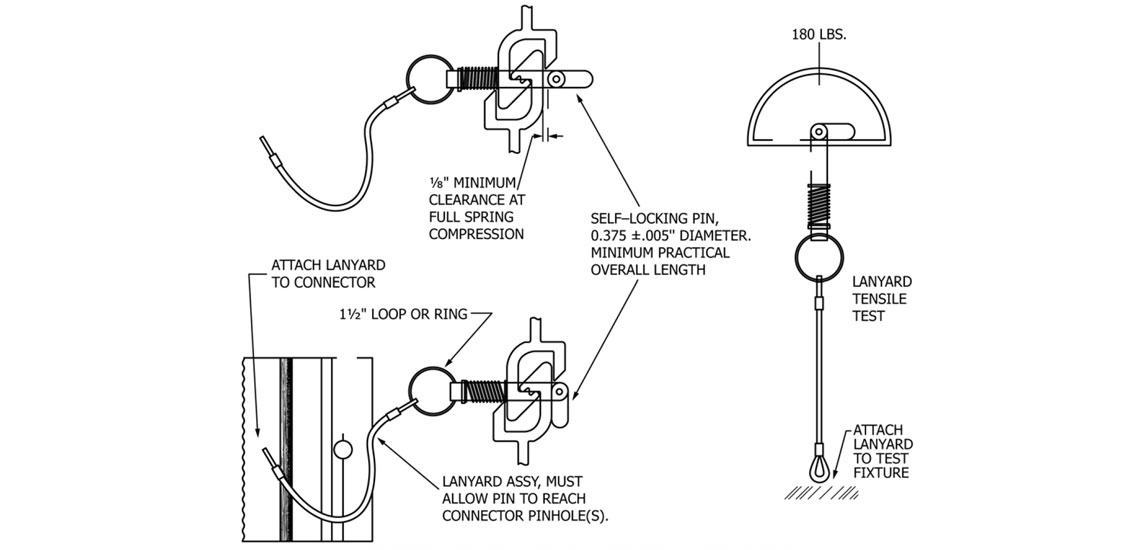
- The Design: The most common standard worldwide is the ASTM “Z” Connector (or Universal Slide). They are usually made of extruded marine-grade aluminium.
- How they work: The end of one boom section has a connector shaped roughly like a “Z,” and the next section has an identical one. They slide together vertically from the top down, creating an interlocking, oil-tight seal.
- Securing the joint: Once slid together, a drop-pin or toggle pin is inserted through a hole in the centre of the connectors to lock them in place so they don’t slide apart in rough waves.
- How they connect: The vertical bar of the floating tow bridle is actually fitted with a boom connector on one side. This allows the tow bridle to slide directly into the end of the oil boom just like another boom section would!