
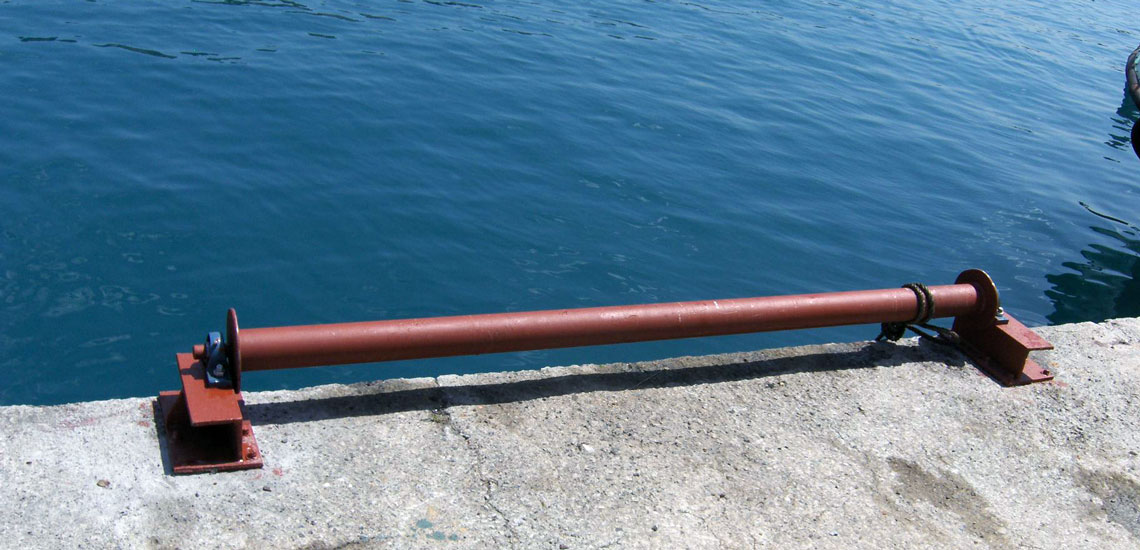
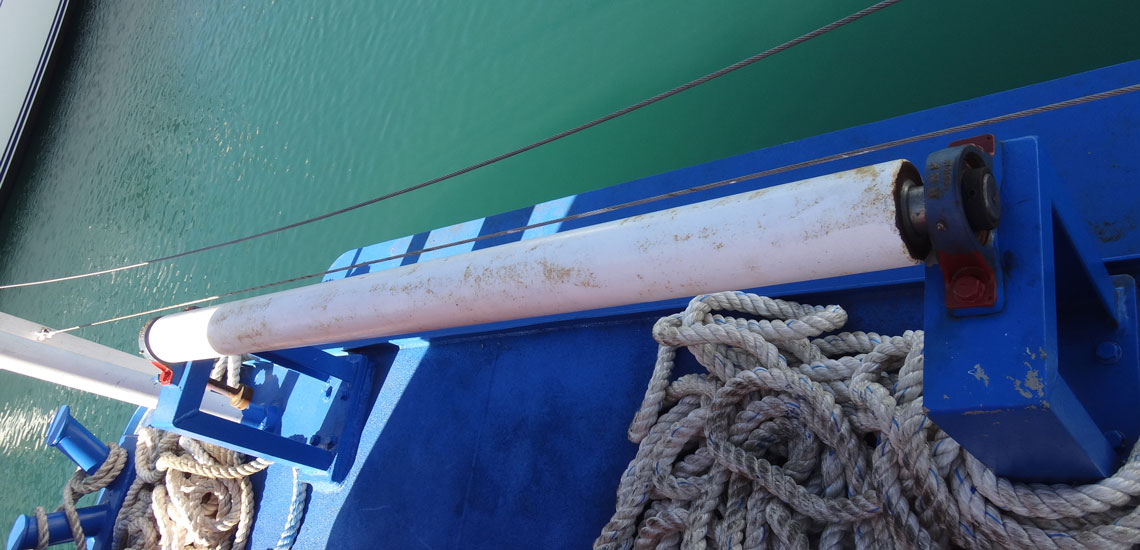
The primary purpose of an oil boom roller (whether it’s an edge roller guide or a motorised storage reel) is to protect the equipment and the crew while rapidly moving massive amounts of heavy containment boom in and out of the water.
Here is why they are essential during an oil spill response:
1. Friction Reduction and Damage Prevention
Oil booms are made of industrial fabrics like PVC or polyurethane. While tough, they are highly susceptible to friction and tearing if dragged over sharp surfaces.
If you try to manually drag 500 feet of heavy, wet boom over the sharp concrete edge of a port wall, the wooden edge of a dock, or the metal gunwale of a boat, the fabric will scrape and chafe. A torn boom is useless, as oil will leak through the holes. Edge rollers provide a smooth, free-spinning barrier that allows the boom to glide effortlessly from the deck into the water without ever touching a sharp corner.
2. Managing Extreme Weight
A dry oil boom is heavy, but a wet boom coated in thick, sticky crude oil is exponentially heavier.
A motorised boom storage reel uses hydraulic power to do the heavy lifting. Instead of requiring a team of 10 exhausted responders to manually haul thousands of pounds of wet, oil-soaked plastic out of the water hand-over-hand, a single operator can use a hydraulic lever to winch the boom directly up over an edge roller and onto the spool.
3. Speed of Deployment
During a spill, every minute counts. The faster the boom is in the water, the less the oil spreads.
Pulling boom out of a folded pile or a storage box by hand is slow and prone to tangling. A boom reel, often paired with fairlead rollers, allows the boom to be deployed in a continuous, rapid, and controlled line straight into the water at speeds that manual labour cannot match.
4. Safer and Cleaner Storage
When the spill is over, the boom is coated in toxic oil and marine debris. Winding it smoothly onto a storage reel keeps the contaminated equipment contained, organised, and off the deck. Hence, it isn’t a slipping hazard for the crew until it can be properly decontaminated.
While the general purpose of a boom roller is always to reduce friction and manage weight, how and why it is used changes completely depending on the specific environment you are operating in.
Here is why you would use a roller in each of these three distinct locations:
1. The Port (Managing Drops & Massive Scale)
Commercial ports use the largest, heaviest oil booms in the industry (offshore curtain booms) because they have to withstand the wake of massive cargo ships.
The Hazard: Ports have sheer, vertical concrete walls (bulkheads) that drop 10 to 20 feet down to the water. If you drag a heavy, rubber boom over a 90-degree concrete corner, the concrete will act like a saw and shred the fabric instantly.
The Roller’s Purpose: Ports rely on heavy-duty, permanent edge rollers bolted directly to the concrete corners, or massive hydraulic storage reels that can carefully lower the boom vertically down the wall without it ever scraping the edge.
2. The Marina (Navigating Obstacles)
Marinas are cramped environments filled with wooden piers, floating docks, metal cleats, and expensive civilian boats. The booms used here are smaller, but the space is much tighter.
The Hazard: When pulling a boom along a dock to surround a leaking yacht, the boom can easily get snagged on a splintered piling or a metal mooring cleat. A single snag can halt the entire deployment or tear the boom.
The Roller’s Purpose: Responders use portable corner rollers. These are small, clamp-on guide wheels that attach temporarily to the corners of the docks. They allow the crew to pull the boom around sharp 90-degree corners through the marina channels smoothly, ensuring the boom glides past obstacles instead of getting caught on them.
3. The Vessel (Retrieval & Deck Safety)
On an Oil Spill Response Vessel (OSRV) or a tugboat, you are dealing with a moving platform on the open water.
The Hazard: Deploying boom from a ship is relatively easy—you drive forward and let it spool off the back. However, retrieving it is incredibly difficult. You have to haul thousands of pounds of wet, oil-coated, slippery rubber straight up out of the water and over the metal edge (gunwale) of a rocking ship. Doing this by hand is dangerous for the crew and ruins the equipment.
The Roller’s Purpose: Ships use a transom roller (a long, horizontal spinning cylinder mounted across the very back edge of the boat). This provides a smooth, frictionless edge to haul the boom over. When combined with a hydraulic storage reel on the deck, the ship’s engine does all the heavy lifting, pulling the oiled boom safely out of the water while keeping the dangerous, slippery mess off the main deck where the crew is walking.